

Ed Wood's first major film, Glen or Glenda, defies the limitations of genre--a form of advertising itself--as if the man had been creating movies for decades. In reality, directors had had about 50 years to investigate the language and possibilities of the medium, from early works including those by Eadweard Muybridge, Thomas Edison, The Great Train Robbery (1903), Melies' A Trip to the Moon (1902), Birth of a Nation (1915), and the brilliant movies of Erich von Stroheim, among many others. Wood, like a Biblical punishment, wipes all of these out of the way with a movie that barely surpasses the hour mark and yet so thoroughly disrupts the ideals of form.
I don't believe Wood was reacting against advertising and media as overtly as the Monkees were in Head, but instead sought a much larger campaign. Wood was giving us his interior autobiography, but because he was attempting to challenge a social rule instead of a business practice, he had to detach himself from the story while at the same time immersing himself in it by taking the lead role to preserve some semblance of truth. Wood was trying to negotiate with the kind of social order advertising seeks to create. To make it easier for him to reveal himself without being associated with his transvestism, he creates a narrative collage which looks so inarticulate on first viewing that the viewer will avoid considering the sexual preferences of the man and wonder how such a "bad" film maker could be given this project. The viewer focuses entirely on what they perceive as his lack of craft, without noticing how thoroughly he tears apart the strictures of movie language. Wood combines straight Hollywood romance, drama, documentary, an army story, and horror in a movie which was supposed to be about another real person--Christine Jorgensen--but which he turned into his own manifesto. If this were Godard stealing a movie production to make a point, it would probably be considered "revolutionary." But the genius Wood remains cinema's idiot.
Perhaps because of his fetish, Wood has a preoccupation with rules and authority, which the transvestite would always be simultaneously avoiding and courting. His movies tend to feature shots of newspapers, for example, as a way of quickly delivering information while also betraying his interest in facts and human communication. To him the newspaper symbolizes truth and reality, or at least reality as authority wants you to see it. The film is full of these symbols. The opening title credits are so stylistically banal, they look torn from a hundred other Hollywood movies from the same era. To truly mark the package as pseudo-authoritarian, Wood even gets a big Hollywood name to slap on it:
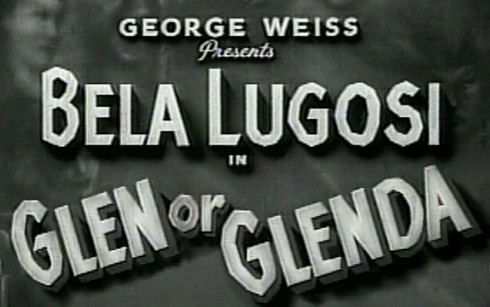
As the film begins, Wood starts his alteration between generic sequences, first sprinting from romance to horror. We have Bela Lugosi, Hollywood icon, as a punishing shadow figure who "[pulls] the strings" controlling the anonymous majority we see throughout the movie. Wood acknowledges that we're all left alone to our own thoughts and existences, but still sets himself outside of this isolated majority as both Glen and Glenda (each performed under the alias Daniel Davis). Like any insecure person, he imagines himself as an irrationally punished loner--he even shows a transvestite after suicide, a way for him to beg for sympathy and understanding. Yet, to assuage his insecurity, Wood frequently has characters in the movie mention how common transvestism and transsexual operations are, taking particular care to differentiate between the two, and also to separate them from homosexuality, which appears to be abnormal to Wood. So desperate, is he, that he shuns certain groups to gain acceptance for himself, in a plea which is perversely endearing in its hypocrisy. It's difficult to find another director whose anxieties are so bare, a fact more amazing when you consider how convoluted Wood makes the narrative in order to hide himself. He's coming out in disguise, particularly by playing himself under a pseudonym (if this were Charlie Kaufman, it would get rave reviews).
Wood's personal schism is also evidenced by his rationalizing the irreconcilable differences between society and his private tastes through the use of Lugosi as the puppet master who chooses sexuality for people. Before it was a trend, Wood was showing us how horror stories inevitably deal with personal sexual anxiety, sexuality ultimately suffering at the whims of society and the majority. When Glen feels like himself and is living his life, the scenes look and feel like a straight romance. Glen worries about marrying Barbara because he'll have to tell her his secret, but they're a fairly solid couple. Glen also visits his transvestite friend Johnny for advice. He has a good social life despite his fear. When forced to reveal his true self to others, though, Glen descends into a horror world. This scenes illustrates his feelings toward exposure:
The lack of background, the oddly framed shots, and the juxtaposition of non-household items within the living room all relate to this speaking in tongues mentioned in the previous post. Art is not meant to show you how something is, but how it feels, which is why fantasy sequences such as this are so powerful. Wood only gives us the more direct scenes, such as the policeman and psychologist conversing, to make facing his darker half easier (the authority figures even approve of transvestism). But even at the wedding is the devil. When reading about Wood's troubles making films and his eventual economic decline, it's obvious that he was able to recreate his real life troubles in dream language, even this early in his career. Glen or Glenda? is a dream he could have easily had.
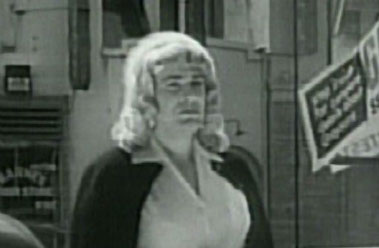 An important sequence which contains the whole of the movie features Glenda walking down the street and stopping to look at women's clothing in a shop window. Here we have Ed Wood directing himself as Daniel Davis playing Glen, who is dressed as Glenda, looking through his reflection at an artificial person, another non-woman, wearing women's clothes. Wood's Glenda does her best to court and intertwine with society by advocating commercialism while also breaking a taboo with her cross dressing. At one point in the movie Wood shows us how transvestism can flourish in the privacy of one's home, telling us that allowing transvestites freedom of expression will make them more productive citizens. This is a civil rights film, which makes his generic deconstruction more powerful because there's a genuine purpose behind the play. In such a naked bid for acceptance, Wood obscures himself as much as an artist can within this scene, worthy of its own entire post. Wood actually uses the formal tropes of costume, film image, and mirror image to deconstruct film artifice by thoroughly piling artifice on top of itself, as if to say that he wants to be naked as a transvestite. A contraction, as he obviously is. That's why he loved movies, which are their own beautiful contradiction.
Wood's work is ultimately concerned with human freedom and security, whether it's the anti-war speeches in Plan 9 from Outer Space, exploitation of the dead in Night of the Ghouls, Jail Bait's criminal psychology, or the integration of sexual honesty in Glen or Glenda?. He's not concerned with the media or with truth, perception, and documentation, as we'll see in the Monkees and Lynch examples, respectively. Wood doesn't want to understand himself so much as he wants to retrofit society to consummate his own ease. He wants us to all be individuals in the mass, without the feelings of loss which were so important in his life. As a young, eager movie fan he threw his own irrational feelings and dream images back at the Hollywood he wanted to be a part of, tearing apart Hollywood's forms as a way of crying for help; to show them how alienated he felt by forcing viewers to feel alienation via his irregular dialog, haphazard sets, and illogical and intuitive scene juxtapositions. Wood is a true artist for allowing his unconscious to speak and flourish through his art, and also for forcing his personality on the world by making such puzzling, elusive movies. He was a great psychologist, and thus a great teacher for his habit of breaking form.
 Next: the Monkees...

No comments:
Post a Comment