Tonight Amy and I went to see The Dark Knight. I wanted her to pick because, technically, I chose the last two. I already saw the movie, which is heavily flawed, but entertaining. The acting is great, though Christian Bale is unfortunately wasted. The real problem with the movie is the script--it's inept. They need to either add an hour or move the Two-Face transformation to the next one in the series. Developing any of the ideas and themes introduced would help, too, but that's not really what I was paying attention to tonight.
It was exactly the kind of date I wanted: sweet, innocent, erotic, heartfelt.
She asked me if "post-mortem Heath Ledger [was my] thing," so when he came into the mob meeting, the first time we really get to see him, I asked if I could hold her arm because that dead guy really scared me. We held hands until our hands cramped, and she felt so nice. She looked beautiful, again: red shirt with a green sweater. These high school girls on my left laughed when I asked her, probably because I'm a 25 year-old asking a woman if I can hold her hand. I like that. It's retarded.
After the movie I was starving, so I got something small to eat. She wasn't hungry. We talked about the movie, her job, and a bunch other things. We got on the subject of swastikas and symbols after I commented on her earrings: the Dharma symbol with a yin/yang in the middle (Lost!). I love listening to her talk because she always has a lot to say and knows so much, plus her voice and way of speaking really turn me on because she's so polite and well-spoken. And she's even cuter when we start to disagree, like when I said all art is a way of practicing psychology and she thought that wasn't true because of work-for-hire systems. Aside from a few good friends and my brother, I've never been able to talk analytically with someone so easily. You try describing the significance you find in something to most people and they give you a frightened look and want to shut you off. She hates racism, prejudice, lack of opinion, and seems to find some point of interest in everything around her. This is the total opposite of my family. And a lot like me. And a lot of what I look for. So, hence, I like her...a lot.
Later we started to say goodbye at her parents' car, but I remembered the Black Keys album I got her, so we walked to my car and I gave it to her. Then we walked back. I guess we spent about 20 minutes making out, and I was happy to continue that kiss from two weeks ago. We just kind of merged for a while, in the dark, while all the high school and junior high kids set free from the mall playpen walked to find their moms' cars. Then one of the moms started the car we were standing behind, so we said goodbye several times and kissed some more. After talking about visiting each other at our own places (she's trying to move in with a friend who lives not far from me), we said goodnight the last time and I walked to my car. I put on "To Sheila" by Smashing Pumpkins and started to feel the way I used to feel driving back to State College, overtaken by how powerful vulnerable feelings can be. They are my favorite feelings, when it's tenderness instead of fear . When you look up to someone so much that they give you that bittersweet feeling--you're crying because you have to part, but you know you'll see them soon, and you feel emotions instead of words. That's one of the things I really want in life. I thought I had it once, but it was not permanent.
Date two went really well. It was a relief, especially after so much serial dating. Amy and I met at the Princeton Record Exchange at 4. She looked beautiful, of course, and we had fun browsing and asking about each other's tastes. She seems to know a little about a lot of groups, while I tend to be more in depth with what I have. I don't follow music as much now, though, so she asked me about a lot that I only knew by name. I was happy to finally have a musical compatriot, though. Not that what I enjoy is particularly rare anymore, but she knew her stuff. She got excited over Mothers of Invention albums, but could talk about Elton John, too.
We walked around after this because I wanted to find a bookstore Lina and I went to when I was there last, which I guess was last summer. I don't think that bookstore is there anymore, which is a shame. It's also hard to believe--it was a nice store. They had some old volumes of Jung's writing which I wanted at some point, though they're probably still available in other editions. We did find one mediocre bookstore, and she picked up a novel for her sister's birthday. We had dinner, after this, at a pizza place she liked. It's funny how often I've fretted some dates, wondering what to expect and what was expected, when Amy is so low key. Charmingly, so (compare this to all the expensive places Jenn wanted me to go to, not that I'm against nicer restaurants). Despite the heat, she wore the same sweater she had on at the museum and had on these old running shoes. But she looked amazing. I love when women dress how they want, instead of trying to look like what they think you want. I preferred her ratty shoes to layers of makeup, easily. I mean that as a huge compliment. I had a good feeling about her from the start, unlike on other dates I've liked where I've hoped for things to click a little more than they did. Amy and I seem to have the right chemistry with enough differences to be interesting. I think we both see ourselves as loners, though we love people while still trying to deal with a need to be ourselves in a world that enjoys conformity. I could tell by the way she talked about art, too, that we'd get along well. She's one of the few people I've met who made me feel like I could be serious. I don't get that from my family, aside from my brother. I don't joke with her as much as I do with most people, which I surprisingly enjoy, because it means we're talking openly and seriously about so much. I can be a human being with her. I never feel like I have to be a performer before I can ever open up.
While we ate, we did discuss religion, which I'd looked forward to (I was curious to see what her beliefs were, specifically). It was a fun conversation, though it took a little while for us to understand each other, but that's how that subject goes. We also talked about the gay high school boy who was murdered recently. This caused some misunderstandings, but in the end we seemed to agree, which was a relief. I was afraid, for a moment, that our compatibility at the museum was a fluke and she had a homophobic streak. But, before long, we were enjoying each other's ideas and walking through Princeton, discussing the houses, our histories, and our likes and dislikes. She's a lot like me, I think. In a way, I feel like I've met myself. With other people I've gone on dates with, I've always thought so much about what could happen, like what we'd be like together. I didn't realize how preoccupied I was with distractions about possibility, instead of focusing on the person. With her, I've felt really relaxed both times we met. I never let fantasy really get in the way, but instead always had her in mind. That's a good thing. I know we'll see each other again, and we'll see where this goes. So far it's been very positive, and I need that, especially after the medical problems.
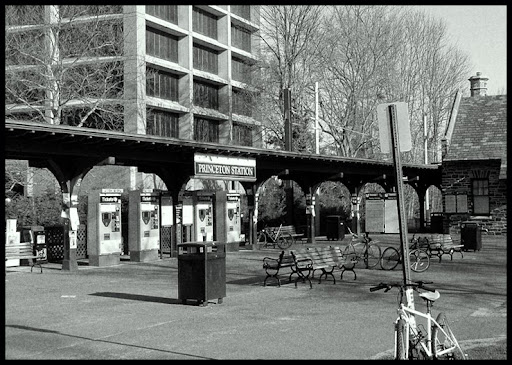
Amy's in Mexico now, building a house with members of her church for some people in need of one. I admire that greatly. She cares about people. Because of that, she couldn't stay out too late last night, so I walked her back to the train station a little early. We talked about movies. She's always wanted to see Blue Velvet and has a taste for old movies, like Nosferatu and The Thin Man. Again, like meeting myself, right? She understood where I was coming from when I joked that too many kids our age don't know anything from before Star Wars and The Godfather.
I knew we were going to kiss at the end of this date, and I guess we both did. I think we only said goodbye two or three times instead of, like, five. We hugged on this bench, tightly, and when we were done I was going to kiss her. Then she said, "This is awkward," which put me off, but I guess she wasn't sure what reaction she'd get to a kiss. So we walked over to the train and she asked if I wanted a kiss. Of course, I did, and we French kissed by the door for a while. Actually, she was pretty intense, which I liked, and which kind of surprised me (but, if she's really like me, it shouldn't). Did I want to kiss her? I'd wanted to since we were leaning over old German pistols in glass cases. Since we looked at ugly British plates. Since I could see that we both loved the minutia and complexity of all this fun stuff around us. She said she'd get in touch when she gets back from Mexico, so I'm looking forward to hopefully meeting next weekend. On my way back to the Spring St. parking garage I popped back into the record store and got the Black Keys record she wanted, but thought was too expensive. It took me a while to find it, because she put it in the wrong spot.
Ed Wood's first major film, Glen or Glenda, defies the limitations of genre--a form of advertising itself--as if the man had been creating movies for decades. In reality, directors had had about 50 years to investigate the language and possibilities of the medium, from early works including those by Eadweard Muybridge, Thomas Edison, The Great Train Robbery (1903), Melies' A Trip to the Moon (1902), Birth of a Nation (1915), and the brilliant movies of Erich von Stroheim, among many others. Wood, like a Biblical punishment, wipes all of these out of the way with a movie that barely surpasses the hour mark and yet so thoroughly disrupts the ideals of form.
I don't believe Wood was reacting against advertising and media as overtly as the Monkees were in Head, but instead sought a much larger campaign. Wood was giving us his interior autobiography, but because he was attempting to challenge a social rule instead of a business practice, he had to detach himself from the story while at the same time immersing himself in it by taking the lead role to preserve some semblance of truth. Wood was trying to negotiate with the kind of social order advertising seeks to create. To make it easier for him to reveal himself without being associated with his transvestism, he creates a narrative collage which looks so inarticulate on first viewing that the viewer will avoid considering the sexual preferences of the man and wonder how such a "bad" film maker could be given this project. The viewer focuses entirely on what they perceive as his lack of craft, without noticing how thoroughly he tears apart the strictures of movie language. Wood combines straight Hollywood romance, drama, documentary, an army story, and horror in a movie which was supposed to be about another real person--Christine Jorgensen--but which he turned into his own manifesto. If this were Godard stealing a movie production to make a point, it would probably be considered "revolutionary." But the genius Wood remains cinema's idiot.
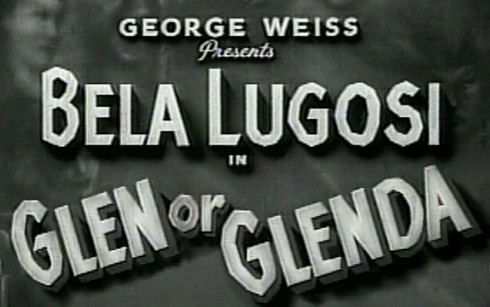
Perhaps because of his fetish, Wood has a preoccupation with rules and authority, which the transvestite would always be simultaneously avoiding and courting. His movies tend to feature shots of newspapers, for example, as a way of quickly delivering information while also betraying his interest in facts and human communication. To him the newspaper symbolizes truth and reality, or at least reality as authority wants you to see it. The film is full of these symbols. The opening title credits are so stylistically banal, they look torn from a hundred other Hollywood movies from the same era. To truly mark the package as pseudo-authoritarian, Wood even gets a big Hollywood name to slap on it:
As the film begins, Wood starts his alteration between generic sequences, first sprinting from romance to horror. We have Bela Lugosi, Hollywood icon, as a punishing shadow figure who "[pulls] the strings" controlling the anonymous majority we see throughout the movie. Wood acknowledges that we're all left alone to our own thoughts and existences, but still sets himself outside of this isolated majority as both Glen and Glenda (each performed under the alias Daniel Davis). Like any insecure person, he imagines himself as an irrationally punished loner--he even shows a transvestite after suicide, a way for him to beg for sympathy and understanding. Yet, to assuage his insecurity, Wood frequently has characters in the movie mention how common transvestism and transsexual operations are, taking particular care to differentiate between the two, and also to separate them from homosexuality, which appears to be abnormal to Wood. So desperate, is he, that he shuns certain groups to gain acceptance for himself, in a plea which is perversely endearing in its hypocrisy. It's difficult to find another director whose anxieties are so bare, a fact more amazing when you consider how convoluted Wood makes the narrative in order to hide himself. He's coming out in disguise, particularly by playing himself under a pseudonym (if this were Charlie Kaufman, it would get rave reviews).
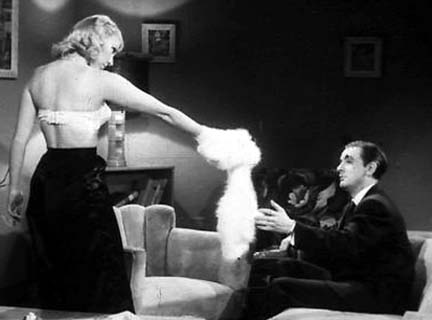
Wood's personal schism is also evidenced by his rationalizing the irreconcilable differences between society and his private tastes through the use of Lugosi as the puppet master who chooses sexuality for people. Before it was a trend, Wood was showing us how horror stories inevitably deal with personal sexual anxiety, sexuality ultimately suffering at the whims of society and the majority. When Glen feels like himself and is living his life, the scenes look and feel like a straight romance. Glen worries about marrying Barbara because he'll have to tell her his secret, but they're a fairly solid couple. Glen also visits his transvestite friend Johnny for advice. He has a good social life despite his fear. When forced to reveal his true self to others, though, Glen descends into a horror world. This scenes illustrates his feelings toward exposure:
The lack of background, the oddly framed shots, and the juxtaposition of non-household items within the living room all relate to this speaking in tongues mentioned in the previous post. Art is not meant to show you how something is, but how it feels, which is why fantasy sequences such as this are so powerful. Wood only gives us the more direct scenes, such as the policeman and psychologist conversing, to make facing his darker half easier (the authority figures even approve of transvestism). But even at the wedding is the devil. When reading about Wood's troubles making films and his eventual economic decline, it's obvious that he was able to recreate his real life troubles in dream language, even this early in his career. Glen or Glenda? is a dream he could have easily had.
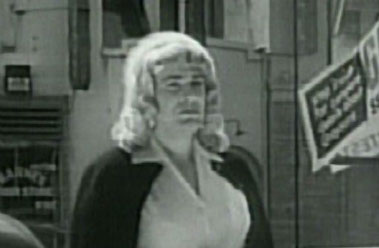
An important sequence which contains the whole of the movie features Glenda walking down the street and stopping to look at women's clothing in a shop window. Here we have Ed Wood directing himself as Daniel Davis playing Glen, who is dressed as Glenda, looking through his reflection at an artificial person, another non-woman, wearing women's clothes. Wood's Glenda does her best to court and intertwine with society by advocating commercialism while also breaking a taboo with her cross dressing. At one point in the movie Wood shows us how transvestism can flourish in the privacy of one's home, telling us that allowing transvestites freedom of expression will make them more productive citizens. This is a civil rights film, which makes his generic deconstruction more powerful because there's a genuine purpose behind the play. In such a naked bid for acceptance, Wood obscures himself as much as an artist can within this scene, worthy of its own entire post. Wood actually uses the formal tropes of costume, film image, and mirror image to deconstruct film artifice by thoroughly piling artifice on top of itself, as if to say that he wants to be naked as a transvestite. A contraction, as he obviously is. That's why he loved movies, which are their own beautiful contradiction.
Wood's work is ultimately concerned with human freedom and security, whether it's the anti-war speeches in Plan 9 from Outer Space, exploitation of the dead in Night of the Ghouls, Jail Bait's criminal psychology, or the integration of sexual honesty in Glen or Glenda?. He's not concerned with the media or with truth, perception, and documentation, as we'll see in the Monkees and Lynch examples, respectively. Wood doesn't want to understand himself so much as he wants to retrofit society to consummate his own ease. He wants us to all be individuals in the mass, without the feelings of loss which were so important in his life. As a young, eager movie fan he threw his own irrational feelings and dream images back at the Hollywood he wanted to be a part of, tearing apart Hollywood's forms as a way of crying for help; to show them how alienated he felt by forcing viewers to feel alienation via his irregular dialog, haphazard sets, and illogical and intuitive scene juxtapositions. Wood is a true artist for allowing his unconscious to speak and flourish through his art, and also for forcing his personality on the world by making such puzzling, elusive movies. He was a great psychologist, and thus a great teacher for his habit of breaking form.
As I revise my novel more and think about the art I like, I keep bumping into the concept of form. I think it's something I've become particularly interested in once I started college. In the future I'll post a bit about what I call the "oppositional voice," the occurrence of some feeling of discontent or opposition with whatever you're doing. This relates to what some call the Imposter Syndrome, or yin and yang; you have Jung and the shadow, God and the devil, and for myself a fixation on being both happy and sad. It seems, sometimes, that there must always be an oppositional voice, which is good and bad. When it works, it's called balance: yin and yang. When it doesn't, you find yourself tearing yourself down, which can relate to all kinds of psychological issues. You sabotage yourself. At my most playful, though, I have a certain desire to resist forms of authority, and form itself is an authority. I want to talk about form within the film medium.
The true language of human beings is nonsense, speaking in tongues (the language of dreams); that is, those things which can be felt, but not expressed. In modern language, the medium of this illogical vocabulary is the collage. In the Industrial Era we all help perpetuate our very human desire to manipulate the environment, no matter our stance, but we do this to a dangerous end (climate change, pollution, etc.). Our reaction to this is to return through art to the language of dreams, the natural language. If our world is a monotonous collage of plastic and concrete playing endlessly with one Home Depot and Wal-Mart every three miles as a kind of time piece or spacial marker, then in defense we create scrambled images to help immerse ourselves in deep emotions and thoughts which can only flourish in our natural setting and must be expressed thusly, partly because that is their nature and also as defense against the assault of advertising. Advertising takes dream language and sucks the meaning out of it in order to have a singular focus: to sell the product. It perverts human language, and we respond with art which revels in the irrational. The art appears meaningless superficially, but in reality is a world of meaning. It's a projection of our interior world, the element of "reality" which we can rely on more than anything else. Advertising truly has no value outside of its ability to push a product, and then its value is relegated to the company it supports. It attempts to create need where there is none. Truly necessary items, such as healthy food or water, aren't advertised. They are part of our natural world and don't need a sales pitch. Other necessities--sleep, creation, love--cannot be sold. Advertising perverts the natural order through its assertion in our lives, and film is a great medium through which to study form because in 2008 so many ads are based on video. The rebels fight back by perverting the medium which perverts.
To discuss, praise, and understand some formal subversion I'll look at a few of my favorite movies, often maligned, which try to decode the rationalism and simplicity which perverts our lives now. These are Ed Wood's Glen or Glenda? (1953), the Monkees' Head (1968), and David Lynch's Lost Highway (1997). Lynch's work from Fire Walk with Me (1992) on has dealt with form very specifically, as does Eraserhead (1977). So perhaps I'll change that section of this series when I get to it, because he truly deserves a major analysis. Wood's work does as well, and he'll be getting a bigger post at some point. I should also mention Orson Welles' 'F' for Fake and perhaps even The Kids in the Hall. Godard's Alphaville (1965) also applies, especially considering that it's an Ed Wood knock-off, but don't tell Criterion Collection. And, of course, you can't forget his Weekend (1967).
On Saturday the 9th I went on a date with this woman Amy, who I met online. We met at noon at the Philadelphia Museum of Art and I have to say, the museum was so engrossing that I feel completely embarrassed for not having visited earlier. I don't think we really went to many museums when I was young, but it's something I've gotten into more in the past few years. Not that I'm a regular, but I think it's going to become that way. I love the tokenism of the human being. Other animals have this, like dogs when they bring you their favorite chew toy. This is like earlier man sacrificing worthy animals or wine casks to gods. We like to collect and deify certain objects to show love to ourselves and each other. The museum is an inspiring way to see this in action. All times and "cultures" collide, as they should, categorized but losing distinction. That's the way I like it. The museum is my ideal island.
I love in particular the plates, the silverware, the preserved rooms. I want so much to go back in time because of my memory and how much I think about the past. This is as close as I can get. Of course, I love the paintings, too, but it's the whole array of objects. You're walking through the attic of an entire planet. I was able to look at Indian art and 16th Century German armor. The armor suit for the ten year-old boy made me sad. The breast piece with the sword wound made me laugh. So did the sword with dried blood still on it. But that's not very funny. What was truly sad was seeing how animalistic the armor was. We create these frightening, anthropomorphic pieces to kill each other because there isn't enough natural hate in us. How terrifyingly sad. If these men had seen each other honestly, face to face, there would have been no piercing. Instead I get to live out glimmers of their pretty real thrashing. For $14. And I love it.
Aside from the intense sensory experience, Amy made the whole trip a complete pleasure. The last date I had that was this enjoyable was with Lina, though I think I enjoyed our time together the rest of that week more than the first date. Regardless, I had a better feeling from Amy. Even walking up to the museum, after I navigated the parkway and found a spot to put my car inside the circle, I could feel it. I suppose the happy people, the sunshine, and the openness didn't hurt. Philadelphia's not a bad looking city, but the museum section of the Franklin Parkway is certainly a highpoint. You're right by one of my major Pennsylvania obsessions, the Susquehanna, and the area is open and green. Amish city life. And you're also staring at this enormous and beautiful building. What more could you want? It was a scene which welcomed me, but was fit for a place better than I was.
Amy works in art preservation, so she knew a lot and we had so much to say. Museums are great for first dates. I learned this with Monika, but compared to Amy that was nothing. Amy is very beautiful and extremely intelligent (well, Monika is too, but this is a different story). She has a delicate manner and politeness which I find attractive because it borders on freakish. Not everyone is polite on a date. Even Monika, sweet as she could be, would be on her cell phone during dinner. Annoying. Amy, instead, gave me a complete education. She also has this way of saying exactly so that she specifically pronounces the t. It's like two words: exact-ly. I thought that was adorable. When I hear the word in my head I can't help giving it that little pause, too. She likes using that word a lot. So she was a freak, which I love, because I am too. I used to tape cartoons and watching them over and over in elementary school so I could understand why I liked them, for Christ's sake. She understands music like I do and we share the museum obsession. So many people are lazy and boring, so it thrills me when I meet one of these rare people. I've done it in real life a few times, like Klaus Yoder, a great man I'll write about here one day. But the internet makes it easier, I suppose because there are so many sites and spots designated for people's individual obsessions. They are magnets and we can more easily find each other. It's one thing I got from the Smile Shop (I finally got to meet some people from there this weekend too--another post). I long to meet people like Amy every day, but it's painfully rare. People say that only freaky, messed up people meet online. Well, it's true, but it's not a negative thing. We're all messed up. You need to embrace it, and decide that it's an integral part of you or something which needs to be fixed. Retards pretend to be normal. There is no normal. The people who can truly live out their passions, these are my heroes. They look like freaks because they're not afraid to express, even if they're pretty shy. They have a strong love inside, a strong sense of consciousness. Sometimes I'm fooled, but it's a call I listen for at all times, because these are my people.
I find that with the freaks, you can have the best friendships and romances, provided they're good people. Many are. The reason is that if they care so much about their hobby, then 1) they're not too clingy because they have their own passion, and 2) they'll care about you just as much. I try to surround myself with these people as friends and girlfriends and also to return that passion as much as I can. My brother, Klaus Yoder, Lina, the people on the Shop, and a few others have been this in my life. Mark Crouse, I think, though I wish I'd appreciated it more. And Matt Anderson, wherever you are. I hope you're not dead.
Obviously, I hope to get the same exchange with Amy. She seems like a very special person. We spent hours in that museum and really connected, and her hug at the end was priceless. Well, first, she took such pains to give a great goodbye and make it clear that she wanted to meet again. I think we said goodbye like five times. But when we really parted we hugged and there was something innocent and childlike about it--a reach. I'm not sure what that was (the surprise of it, maybe). I just want to feel it again. Especially after all the bullshit I went through and put myself through. I called Amy tonight to see if she wanted to go to the Princeton Record Exchange next weekend, which we talked about before. She was at work, so I had to leave a message. So we'll see what happens. But it was a good date and, honestly, my favorite date.